
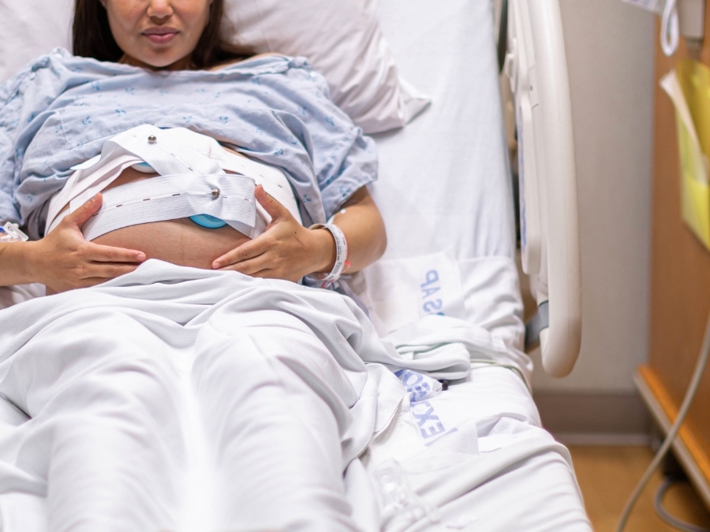
Induced labor is the medical stimulation of labor when natural labor hasn’t started, either after the pregnancy reaches full term or in emergency situations that require speeding up delivery. The method used depends on cervical readiness and the condition of the baby.
How the Type of Induced Labor Is Determined
The doctor first performs a vaginal examination to assess:
- Cervical dilation.
- Cervical softness.
- Whether the amniotic sac has ruptured.
Based on the results, the appropriate induction method is chosen:
- Cervix closed, not soft, amniotic sac intact:
- The doctor uses a vaginal insert (suppository) or gel to prepare the cervix.
- Sometimes a balloon catheter is used to help dilate the cervix.
- Cervix soft and partially dilated, amniotic sac intact:
- The doctor may manually rupture the amniotic sac to stimulate labor.
- Sometimes an IV labor induction (oxytocin) injection is used if labor doesn’t start spontaneously.
- Cervix soft and dilated, amniotic sac ruptured:
- IV labor induction (oxytocin) is given to stimulate uterine contractions.
Types of Induced Labor
1. Vaginal Insert or Gel
- Contains prostaglandin hormone to prepare and gradually open the cervix.
- Suppositories: release the hormone continuously for up to 24 hours.
- Gel: applied every 6 hours depending on cervical dilation.
- Usually used when the cervix is not yet ready for labor.
2. Balloon Catheter Induction
- A small balloon is inserted into the cervix and filled with water to gently press on the cervical walls.
- Stimulates the body to release natural labor hormones.
- Typically left for up to 12 hours, and the woman can move around.
- Often additional methods are needed to start full labor.
3. Manual Induction (Rupturing the Amniotic Sac)
- If the cervix is soft and dilated but the amniotic sac hasn’t ruptured, the doctor creates a small hole in the sac to release the amniotic fluid and stimulate labor.
- In some cases, IV oxytocin is needed afterward to strengthen contractions.
4. IV Labor Induction (Oxytocin)
- Administered via intravenous injection.
- Contains oxytocin, the natural hormone that triggers contractions.
- Dose starts low and gradually increases until regular and strong contractions begin.
- The baby and contractions are continuously monitored with CTG.
Key difference between IV oxytocin and vaginal inserts:
Method | How it works | When used |
Vaginal insert/gel | Gradually prepares the cervix | If the cervix is not ready for labor |
IV oxytocin | Directly stimulates contractions | If labor has started but contractions are weak or irregular |
Duration of Induced Labor
- Varies between women, from a few hours to over 24 hours.
- If the cervix is mostly closed or very small (1 cm), induction may take two days or more.
Reasons Labor May Not Respond to Induction
- Pregnancy less than 41 weeks
- Mother’s age over 30
- Cervical dilation less than 2 cm
- First pregnancy
- Severe obesity
- Pregnancy complications (pre-eclampsia, high blood pressure, gestational diabetes, etc.)
At the Obstetrics & Gynecology Department at Al Ahli Hospital, we ensure a safe and smooth experience, with continuous monitoring during all stages of induced labor to guarantee the safety of both mother and baby.
References
- Women's and Children's Health Network - Induction of Labour
- Pregnancy Birth and Baby - Induction of labour
- National Women's Health/Auckland District Health Board - Induction of labour
- The Royal Women’s Hospital - INDUCTION OF LABOUR
- Obstetrics & Gynecology - Incidence of and Risk Factors for Failed Induction of Labor Using a Contemporary Definition
- NLM - The Risk Factors for Failure of Labor Induction: A Cohort Study