
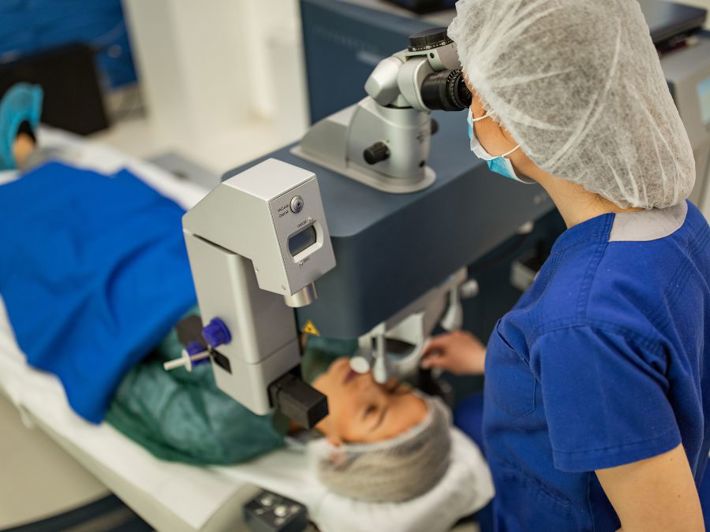
With scientific advancement, vision correction has become easier than ever, thanks to various laser techniques, such as LASIK, Femto LASIK, SMILE, and surface LASIK, among others. However, due to this diversity, many people are confused about these techniques and the differences between them.
First, it is important to note that all vision correction surgeries rely on laser technology, which is why they are collectively called laser eye surgeries. The difference lies in the details of each technique. In this article, we will explain the difference between two popular techniques: LASIK and Femto LASIK.
Difference Between LASIK and Femto LASIK
LASIK is the traditional and older method of vision correction. During the procedure, the cornea is lifted using a very thin surgical blade, then a special laser is applied to the depth of the cornea to permanently correct it, and finally, the cornea is repositioned.(1)
On the other hand, Femto LASIK is a modern modification of LASIK, using laser completely throughout the procedure (100% laser) without any surgical instruments such as a blade. During the procedure, the cornea is lifted using a femtosecond laser, and another laser is applied to the cornea’s depth for correction, making the procedure more precise and safer than traditional LASIK.(2)
Which is Better: LASIK or Femto LASIK?
Both techniques are highly effective in correcting vision, but Femto LASIK offers several advantages, including:(2)(3)
- More accurate vision correction and higher safety.
- Ability to treat higher degrees of myopia.
- Faster recovery after the procedure.
- Greater control over the thickness and area of the cornea lifted, tailored to each patient’s needs.
- Lower risk of corneal displacement due to stronger laser stabilization instead of a surgical blade.
- Reduced likelihood of dry eye, a common side effect of traditional LASIK.
- Lower risk of accidental corneal scratches or injury during the procedure.
- Increased patient reassurance knowing that no surgical blade is used.
However, Femto LASIK may involve slightly higher costs and a temporary sensitivity to light.(2)
Ultimately, the best choice for vision correction depends on several factors, including the health of your eyes and cornea, among other criteria. If you are unsure, Al-Ahli Hospital Ophthalmology Department offers:
- Consultations with highly experienced ophthalmologists to determine the most suitable technique.
- The latest vision correction technologies to ensure optimal results.
- Comprehensive care before and after the procedure.
What About Other Types of Laser Eye Surgeries?
There are several other laser eye techniques available,including: (4)(5)
- Surface LASIK (PRK): No corneal flap is lifted in this type. A thin surface layer of the cornea is removed using a solution or special material, then a laser is applied for correction. This layer regenerates after surgery. Recovery is longer, but it is excellent for patients with thin corneas unsuitable for other methods.
- SMILE: Used for treating myopia only. A small portion of the corneal surface is cut, and the laser corrects vision at the cornea’s depth. It is similar to LASIK in effectiveness and safety, with a lower risk of dry eye or corneal displacement.
- Contoura Vision (Topography-Guided LASIK): The latest and most precise technique. A detailed map (fingerprint) of each eye is created, and vision is corrected according to this map, improving visual strength and quality simultaneously.
References
Harvard Health Publishing - LASIK Surgery: What to expect
All About Vision - Bladeless LASIK: Femtosecond laser eases LASIK fears
NIH NLM - Femto-lasik: The recent innovation in laser assisted refractive surgery
MSD MANUAL - Surgery for Refractive Errors
Stanford Health Care - Wavefront-LASIK (Custom LASIK)


