
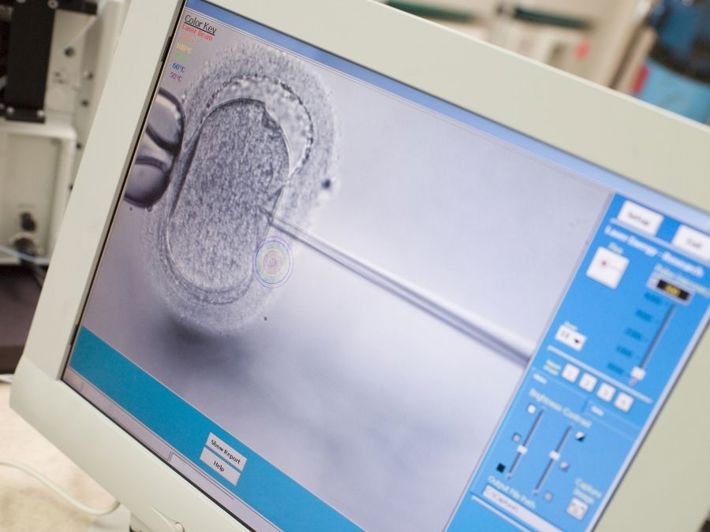
Many options are now available for couples facing difficulty or delay in conceiving, including Intracytoplasmic Sperm Injection (ICSI) and In Vitro Fertilization (IVF).
ICSI is an advanced form of IVF. In both procedures, fertilization occurs in the lab outside the womb after collecting eggs and sperm from the couple, but the difference lies in how fertilization is achieved. Here are the details: (1)
How do ICSI and IVF differ?
ICSI is an advanced technique added to IVF in certain cases.
Both procedures follow the same basic steps where the eggs are retrieved from the woman, then fertilized in the lab to create embryos.After that, the embryos are transferred into the woman’s uterus. The difference is in fertilization:
In IVF (conventional), multiple sperm are placed with the eggs in a lab dish, and fertilization occurs naturally without intervention.
Whereas in ICSI, a single sperm is selected and directly injected into the egg using a fine needle. This ensures fertilization without waiting for it to occur naturally. (2)
Which is better?
ICSI is considered better in cases of severe male infertility, such as very low sperm count,poor sperm quality, or poor sperm motility. Here, the best sperm is selected and directly injected into the egg, improving the chances of pregnancy compared to standard IVF. (3)
However, ICSI offers no particular advantage in cases of female infertility or unexplained infertility. In these cases, both IVF and ICSI have similar success rates. IVF is usually attempted first because it is less costly, and ICSI is used if male infertility is detected or if IVF attempts fail.(4)
How are ICSI and IVF performed?
The steps of both procedures are generally as follows:(4)
- Ovarian stimulation: The woman receives medication for 7–14 days to stimulate multiple egg production, followed by a trigger injection once the eggs are mature.
- Egg retrieval: Eggs are collected from the ovaries using a thin needle under anesthesia to prevent pain.
- Fertilization:
- IVF: Sperm is added to the eggs in a lab dish to allow natural fertilization.
- ICSI: The embryologist selects the best sperm and injects it directly into each egg using a fine needle.
- Embryo development: Fertilized eggs are kept in an incubator for 2–5 days to develop into embryos.
- Embryo transfer: One or more embryos are placed into the woman’s uterus.
- Pregnancy test: About two weeks after embryo transfer, a test is performed to check whether pregnancy occurred.
IVF & Fertility Center at Al Ahli Hospital
Our experts are always available to help couples determine the most suitable option. We first conduct comprehensive tests for both partners to identify the cause of infertility, then work together to select the best technique.
Trust our center, where we use the latest and most advanced reproductive technologies in a safe, comfortable, and private environment.
Book your appointment today and take a step closer to parenthood.
References
- Guy’s and St Thomas’ Specialist Care - ICSI vs IVF
- Cleveland Clinic - Intracytoplasmic Sperm Injection (ICSI)
- MedPark Hospital - What are the differences between IVF and ICSI?
- Betterhealth - Assisted reproductive technology – IVF and ICSI


