
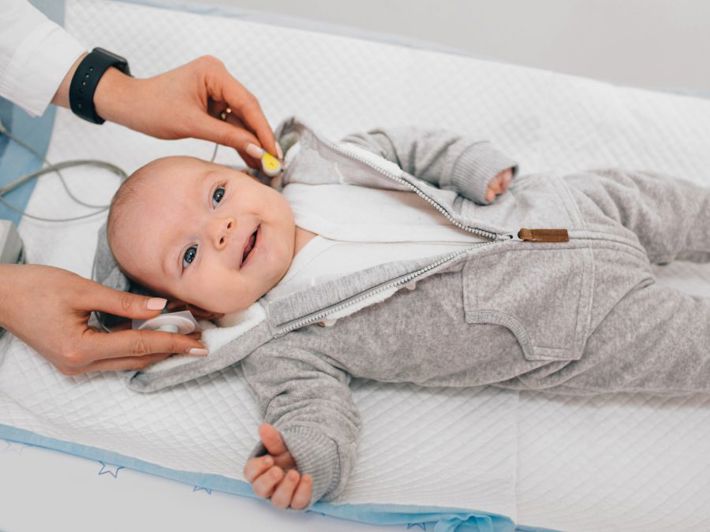
Hearing tests help determine your child’s hearing ability by identifying the softest sounds they can hear at each frequency in each ear. (1)
Why is a hearing test important for your child?
A hearing test helps detect any hearing problems early, especially during the first years of life, when your child cannot yet express the issues or symptoms they experience. (2)
Without testing, your child may have undetected hearing loss for months or even years, which can negatively affect speech development, pronunciation, learning, and social interactions. Early detection increases the chances of effective intervention and successful treatment, ensuring healthy development without negative impacts. (2)
When should a child have a hearing test?
Hearing tests are recommended for the following age groups: (2)
- Newborns: Hearing tests are advised before leaving the hospital or within the first few days after birth. If not done in the hospital, it is recommended to do it as soon as possible, ideally within the first month.
- School age: Another test is recommended around ages 4–5, either through school or accredited audiology centers.
- At any age if hearing issues are suspected: Regardless of age, a hearing test should be performed if there are red flags, such as not responding when called, frequent mispronunciation of words, or turning up the TV volume excessively.
Types of hearing tests for children
There are several types of hearing tests for children, from newborns and infants to older children:
Newborn tests
These are simple and safe tests done while the baby is asleep:
- Otoacoustic Emissions (OAE): A small device is placed in the ear that emits soft clicking sounds. The device’s microphone measures the ear’s responses. (3)
- Auditory Brainstem Response (ABR): Small electrodes are attached to the forehead and behind the ear. Tiny earphones play clicking sounds, and the brainstem’s response is measured. (3)
Infant tests (6 months–2 years)
- Visual Reinforcement Audiometry (VRA): Measures the child’s response to sound using visual rewards like lights or toys. The sound level is adjusted to determine the softest sounds the child can hear. (2)
Young children (2–5 years)
- Play Audiometry: Sounds are played through headphones or speakers. The child performs a simple task when they hear the sound, such as putting a ball in a basket. The sound level is adjusted to find the softest audible sound. (2)
Older children (5+ years)
- Pure Tone Audiometry: Headphones are placed on the child’s head, and tones of varying frequencies and volumes are played. The child presses a button when they hear a sound. (2)
- Speech Discrimination Testing: Simple words are played at different volumes, sometimes with background noise. The child repeats the words they hear. (4)
At Al Ahli Hospital, we offer the latest audiometry technologies under the supervision of expert audiologists to detect hearing issues early and provide a personalized treatment plan.
How to read a child’s audiogram
An audiogram shows your child’s response to different sounds in terms of frequency and intensity.
- Frequency: Shown along the top/bottom of the graph, from 250 to 8000 Hz. This covers the normal range of sounds children hear in daily life, from low to high.
- Intensity: Shown on the left side, from -10 to 110 dB, representing the softest sounds your child can hear. (1)
Symbols on the graph indicate the softest sound your child responded to at each frequency: (1)
- X: Left ear response
- O: Right ear response
- S: Response through headphones (shows hearing strength for both ears together or for the stronger ear if ears differ)
Normal hearing range: -10 to 15 dB across all frequencies (0–20 dB for children tested via headphones). (1)
Degrees of hearing loss in children
Based on the results, a child’s hearing may be normal or fall into one of four categories: (5)
- Mild hearing loss: Difficulty hearing distant sounds, low-volume sounds, or hearing in noisy environments.
- Moderate hearing loss: Affects daily communication, may require hearing aids.
- Severe hearing loss: Difficulty understanding speech; the child may be a candidate for a cochlear implant.
- Profound hearing loss: Can only hear very loud sounds; often requires a cochlear implant.
References
- BC Children's Hospital - What is an audiogram?
- NHS - Hearing tests for children
- University of Rochester Medical Center - Types of Hearing Tests for Babies and Children
- MedlinePlus - Hearing Tests for Children
- Hear and Say - Children’s hearing test